By: The Obnews Editorial Team
NEW DELHI — In millions of Indian homes, gold serves a financial purpose that goes far beyond weddings, festivals, inheritance and tradition. The jewellery stored in cupboards, bank lockers and family safes can become an emergency fund, collateral for a loan, money for school fees, capital for a small business or cash for a medical bill when conventional borrowing is unavailable or simply too slow.
Indian households are estimated to hold roughly 25,000 to 35,000 tonnes of gold, with much of that wealth held as jewellery rather than financial products. Estimates cited in financial and industry research place the value of this privately held stock in the trillions of dollars, while more than 85 per cent of Indian households are estimated to own at least some gold.


For wealthier families, gold may be one part of a much broader portfolio containing property, equities, fixed deposits and other investments. For lower-income households and families earning irregular or informal incomes, however, a few bangles, chains or wedding pieces can represent one of the most valuable assets available when money is suddenly needed.
The Emergency Fund Sitting in the Cupboard
India has dramatically expanded access to formal banking over the past decade, but possessing a bank account does not automatically provide access to affordable credit. A household can have an active bank account and still struggle to qualify for an unsecured loan because the borrower has irregular earnings, no salary slips, limited credit history or income that does not fit a traditional lender’s underwriting requirements.
Gold changes that equation because a gold-backed lender can assess the asset itself rather than relying entirely on the borrower’s income profile. The purity, weight and market value of the jewellery can provide the collateral necessary to release funds quickly, giving people with limited conventional credit histories another way to access formal borrowing.
That speed is especially important when the expense cannot wait for a lengthy approval process. A hospital may require an advance, a school may be waiting for fees, a shopkeeper may need inventory immediately or a family may suddenly face travel, repair or household expenses that cannot easily be postponed.


In those situations, gold can function almost like a private line of credit stored inside the household. It is not as convenient as money already sitting in a bank account, but it can be converted into liquidity far more quickly than many other physical assets.
Families Often Pledge Gold Before Selling It
There is an important financial and emotional difference between selling jewellery and borrowing against it. Selling permanently removes an asset that may have been inherited across generations, while pledging the jewellery gives the family the possibility of recovering it once the debt has been repaid.
That distinction helps explain why gold-backed lending has become such an important part of India’s consumer-credit system. The source material reviewed for this article cites mid-2026 estimates placing bank gold loans at approximately ₹5.1 trillion and NBFC gold-loan books at about ₹3.3 trillion, demonstrating the scale of the formal market that has developed around household gold.
Even with that rapid growth, only a relatively small portion of India’s household gold is believed to have been monetized through organized lenders. The remainder continues to sit inside homes and lockers, effectively remaining dormant until a household encounters a reason to convert that stored wealth into immediate cash.
Women Are Central to India’s Gold Economy
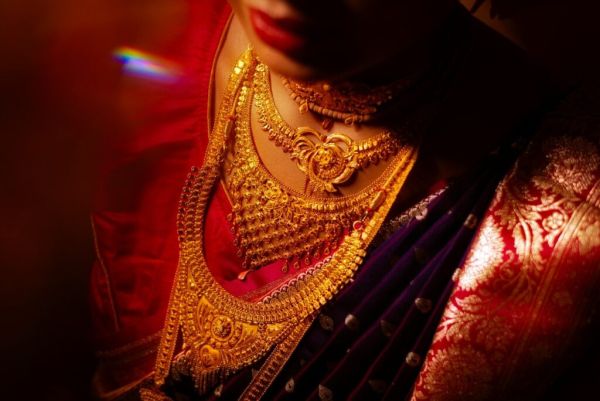
The economics of household gold cannot be separated from its cultural and social role, particularly for women. Jewellery transferred through marriage, gifts and inheritance has historically provided women with a form of financial security that can remain accessible even when the household has few other liquid assets.
The concept of streedhan also gives certain assets received by women through marriage and family relationships particular cultural and legal significance. In practical household finance, this can mean that jewellery becomes one of the few substantial stores of value available to a woman when a family experiences financial stress.
This role is especially visible in parts of southern India, where gold ownership and gold-backed borrowing have long been deeply embedded in household financial behaviour. Families may pledge jewellery to pay school fees, cover health expenses, purchase inventory or finance important family events, then attempt to recover the jewellery when income improves.
None of this makes jewellery equivalent to cash or a conventional investment account. Jewellery can carry significant making charges, stones may have little resale value, and the amount recovered through a sale may be considerably below the amount originally paid.
The Formal and Informal Gold-Loan Economy
India’s gold-credit system ranges from major banks and regulated non-bank financial companies to local jewellers, pawnbrokers and informal moneylenders. These different channels can provide the same basic service of turning jewellery into immediate liquidity, but the interest rates, documentation requirements and consumer protections can vary dramatically.
Organized gold loans can carry substantially lower borrowing costs than informal credit, while borrowing from an unregulated lender can become extremely expensive. Historical research cited in the source material suggests informal lenders once represented a large share of the gold-loan market, although banks and NBFCs have increasingly expanded into regions and customer groups once dominated by local lenders.
That shift creates a difficult challenge for regulators because stronger documentation and ownership requirements can protect borrowers and reduce abuse. At the same time, families may possess ancestral jewellery that has changed hands for decades and comes with no receipt, certificate or original purchase record.
If formal lending requirements become too difficult for those families to satisfy, some borrowers may return to unregulated alternatives despite the higher cost. The challenge is therefore not simply expanding regulation, but ensuring that regulated credit remains accessible to the very households that gold-backed lending is supposed to serve.
Chit Funds, Relatives and Shopkeeper Credit Fill the Gaps
Gold is only one part of a much larger informal household financial system operating alongside India’s banks. Chit funds, known in some regions as kuri, allow participants to contribute money regularly while members periodically gain access to a larger lump sum that can be used for business expenses, education, weddings or other major purchases.
Family loans, shopkeeper credit and community borrowing also remain important, particularly among households whose incomes change substantially from one month to another. These arrangements survive because they can be more flexible than formal credit products and because the lender may personally understand the borrower’s work, family situation and ability to repay.
That flexibility can also create serious risks, especially when the arrangement falls outside regulated financial institutions. Informal loans may carry high interest rates, while unregistered schemes can expose participants to fraud, non-payment or the loss of money with little practical recourse.
Gold remains different from most of these arrangements because the borrower already owns the asset being used to secure the loan. That makes it particularly useful in emergencies, but it also means that failure to repay can result in the permanent loss of jewellery carrying both financial and sentimental value.
Gold Has a Major Remittance Story Too
Gold’s role in Indian household finance extends well beyond India’s borders and into some of the world’s largest migration corridors. For generations, workers travelling between Gulf countries and India have brought jewellery home as gifts, wedding assets, savings and portable stores of family wealth.
The source material also discusses the historical relationship between gold and hawala or hundi, informal value-transfer systems that operate outside conventional banking channels. Such underground financial networks can violate India’s foreign-exchange and anti-money-laundering laws, and authorities have repeatedly taken enforcement action against illegal transfer networks.
It is therefore important to distinguish between lawful personal ownership or transportation of jewellery and participation in an illegal financial network. Families legally purchasing gold, carrying jewellery within applicable customs rules or sending money through regulated remittance channels should not be conflated with criminal smuggling or underground banking operations.
Gold nevertheless became attractive across migration corridors for understandable economic reasons. It is compact, globally recognizable, relatively liquid and capable of storing substantial value in an object that can physically move with the owner.
Why Gold Survived the Digital Banking Revolution
India is now home to one of the world’s most sophisticated digital-payment ecosystems, and consumers can move money electronically in seconds through services that barely existed a generation ago. Yet the rise of digital payments has not eliminated the household role of physical gold because payments technology and access to credit solve two very different problems.
A digital payment system makes it easier to move money that someone already possesses, while gold can create liquidity when that money does not exist. A household with ₹2,000 in the bank and ₹200,000 worth of jewellery may be digitally connected while still relying on physical gold to deal with a major financial emergency.
This distinction helps explain why gold-backed lending can grow alongside digital banking rather than disappearing because of it. Technology can make the process of valuing, lending against and repaying gold more efficient without eliminating the fundamental reason families hold the asset.
The Risks Behind the Safety Net
Gold’s usefulness as an emergency reserve does not make it risk-free. Borrowers who cannot repay a gold loan may lose their jewellery through auction, while high informal interest rates can transform a temporary cash shortage into a much larger household debt problem.
Jewellery itself is also an imperfect investment because making charges, retail markups and stones can reduce the amount recovered when it is sold. Gold sitting unused in a locker generates no income, while capital invested in businesses, equities or other productive assets can potentially generate returns over time.
There is also an emotional cost that cannot be captured on a balance sheet. A wedding necklace, family heirloom or mother’s bangles may represent decades of family history, which means pledging or selling those pieces can feel very different from withdrawing cash from an ordinary savings account.
That emotional attachment is one reason many families prefer pledging jewellery rather than selling it outright. Borrowing against gold preserves the possibility that the asset will eventually return home, even if the household temporarily needs to use its financial value.
India’s Relationship With Gold Is Changing
There are signs that younger Indian households are beginning to interact with gold differently from previous generations. Bars, coins, exchange-traded products and investment-oriented forms of gold have expanded, while some younger families may be more willing to sell inherited jewellery to finance education, a home or another major life goal.
Banks and NBFCs have also brought a growing share of gold-backed borrowing into the regulated financial system. These changes can make household gold easier to monetize while reducing dependence on informal lenders charging far higher rates.
The deeper pattern, however, has not disappeared because gold continues to solve a problem that banking reform alone has not fully eliminated. Families still need access to significant amounts of money quickly, including households with irregular incomes or limited conventional borrowing options.
India may therefore be building a highly digital financial future while simultaneously retaining one of the oldest forms of household financial security. The jewellery sitting inside a family home can be sentimental property, inherited wealth, social insurance and emergency collateral at exactly the same time.
For millions of families, that combination explains why gold has remained remarkably resilient through generations of economic transformation. It may appear to be jewellery during ordinary times, but when a hospital asks for an advance, a business needs inventory or the household faces an unexpected financial shock, it can quickly become the family’s private financial reserve.
Disclaimer
This article is provided for general informational and editorial purposes and should not be considered financial, investment, legal, tax, lending or remittance advice. Interest rates, gold valuations, customs regulations, foreign-exchange laws, lending rules and eligibility requirements may vary between institutions and jurisdictions and can change over time.
References to informal lending, hawala, hundi, cash couriers or other alternative transfer systems are included solely for journalistic and explanatory purposes. The Obnews does not encourage the use of illegal or unlicensed financial channels, and readers should use regulated financial institutions and seek qualified professional advice when making decisions involving borrowing, gold, investments, remittances or cross-border transfers.
Contact to : xlf550402@gmail.com
Copyright © boyuanhulian 2020 - 2023. All Right Reserved.